TL;DR
Choosing between the old and new tax regimes is a pivotal decision for salaried individuals in India. While the old regime rewards specific investments like PPF, ELSS, and home loans through deductions, the new regime—now the default—offers lower tax rates and a simplified structure without requiring extensive proof collection.
For many, the new regime is increasingly attractive because it provides tax-free income of up to ₹12.75 lakh. It promotes better cash flow and goal-based investing rather than locking money into low-return products just to save tax. Even if you missed the March 31st deadline for the employer declaration, you can still switch regimes when filing your final income tax return. Ultimately, unless your deductions are exceptionally high, the new regime’s simplicity and flexibility often outweigh the marginal savings of the old system.
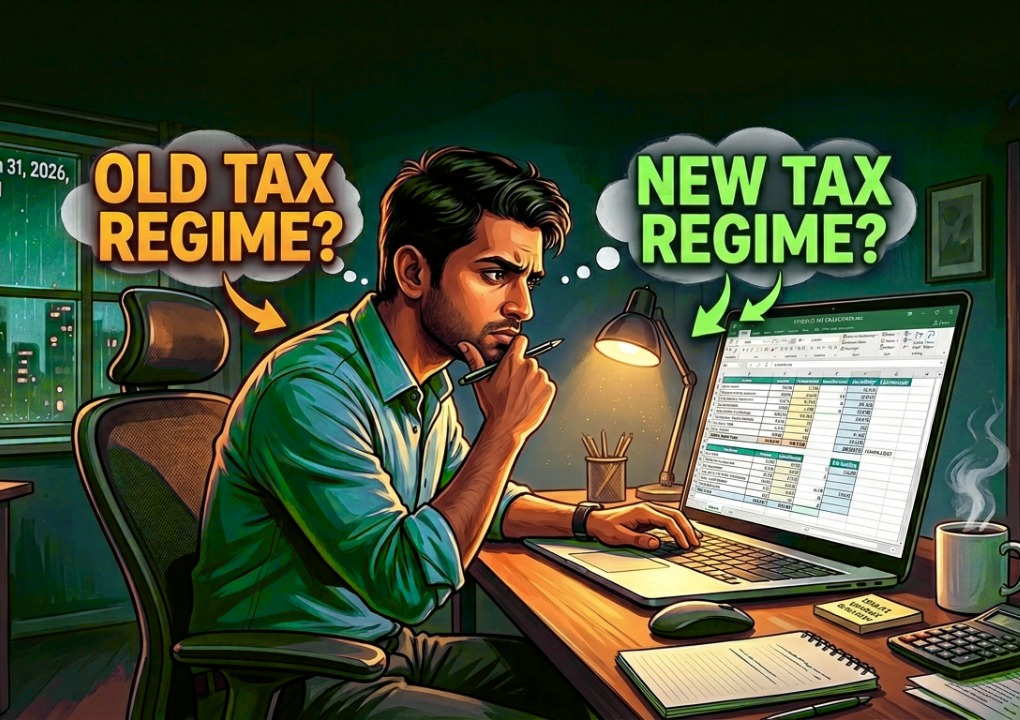
On the evening of 31st March, Rohan sat with his laptop open, staring at his tax worksheet.
Like every year, the same question returned.
“Should I choose the old tax regime or the new one?”
He had a few investments, some insurance premiums, a home loan, and the usual Section 80C deductions. But this year felt different. His colleague had casually said over lunch, “The new regime is now default, and honestly, it is better for most people.”
Rohan was not convinced.
And then came the bigger worry.
“What if I miss the deadline? What if 31st March has already crossed? Am I stuck?”
If this sounds familiar, you are not alone. Thousands of salaried individuals across India face the same confusion every year.
Let us simplify this not just from a tax perspective but also from a financial planning lens.
Understanding the Shift: Why the New Tax Regime Is Becoming Dominant
Over the last few years, the Indian tax system has gradually shifted towards a simpler structure.
The new tax regime was introduced with lower tax rates but without most deductions. Initially, many taxpayers stayed with the old regime because they were already invested in tax-saving instruments.
However, recent changes have made the new regime far more attractive.
The most important shift is this:
The new regime now offers an effective tax-free income up to approximately ₹12.75 lakh for salaried individuals.
This happens because of:
- Standard deduction
- Rebate under Section 87A
- Revised tax slabs
For many salaried individuals, this means:
- You may end up paying zero tax without needing to invest in multiple tax-saving instruments.
This fundamentally changes how one should think about taxes.
Old vs New Regime: The Real Difference
Let us break this down in simple terms.
Old Tax Regime
The old regime rewards you for investing and spending in specific ways.
Common deductions include:
- Section 80C investments like ELSS, PPF, and LIC
- Health insurance under Section 80D
- Home loan interest
- HRA benefits
At first glance, this looks beneficial. But there is a hidden cost.
To save tax, you are often forced into financial decisions that may not align with your goals.
New Tax Regime
The new regime removes most deductions but offers:
- Lower tax rates
- Simplified structure
- Higher rebate thresholds
It essentially says:
“Do not invest for tax savings. Invest in your life goals.”
This shift is significant.
A Practical Comparison: Who Benefits More?
Let us revisit Rohan.
He earns ₹12 lakh annually.
Under the old regime, to reduce his taxable income significantly, he needs to:
- Invest ₹1.5 lakh under 80C
- Pay insurance premiums
- Possibly have a home loan
- Track multiple deductions
Even after all this, the tax savings may not be substantial.
Under the new regime, with minimal effort, his tax liability may already be close to zero due to the rebate structure.
Now ask yourself:
Is it worth locking money into products just to save tax?
Why the New Regime Is Winning for Most Salaried Individuals
There are three key reasons behind this shift.
1. Simplicity
The new regime eliminates complexity.
No need to:
- Collect proofs
- Submit declarations
- Track multiple deductions
This reduces both mental and administrative burden.
2. Better Cash Flow
Under the old regime, tax savings often meant locking money.
Examples include:
-
- PPF with long lock-in
- ELSS with 3-year lock-in
- Insurance policies with long commitments
The new regime allows you to keep more liquidity.
This improves financial flexibility.
3. Behavioral Advantage
One of the biggest mistakes people make is confusing tax saving with wealth creation.
Many individuals invest in:
- Low-return insurance products
- Unsuitable tax-saving instruments
- Unnecessary fixed commitments
just to save tax.
The new regime removes this distortion.
It encourages goal-based investing rather than tax-driven investing.
But Is the Old Regime Completely Irrelevant?
Not entirely.
There are still specific cases where the old regime may work better.
For example:
- Individuals with large home loan interest
- Those with high HRA benefits
- People are already committed to significant deductions
If your total deductions are very high, the old regime can still be beneficial.
However, this applies to a smaller segment of taxpayers today.
The Big Question: What If You Miss 31st March?
This is where most confusion lies.
Let us clarify this.
For Salaried Individuals
Even if you do not choose your tax regime before 31st March:
- Your employer may deduct TDS based on default assumptions
- But you can still choose the regime while filing your income tax return
This means:
You are not locked in permanently just because the financial year has ended.
You still have flexibility at the time of filing your return.
Important Distinction
- Employer selection is provisional
- Final choice happens at the ITR filing stage
So if Rohan missed making a declaration before 31st March, he can still carefully evaluate both regimes when filing his return and choose the more beneficial one.
A Story That Reflects Reality
Let us consider another example.
Meera, a 38-year-old working professional, always chose the old regime.
Why?
Because her advisor once told her:
“Save tax under 80C.”
Over time, she accumulated:
- Multiple insurance policies
- Fixed deposits
- Random ELSS funds
But when she reviewed her portfolio, she realized:
- Her returns were suboptimal
- Her liquidity was restricted
- Her investments were not aligned with her goals
When she switched to the new regime, something interesting happened.
She stopped chasing deductions.
Instead, she started:
- Building an emergency fund
- Investing in diversified equity funds
- Planning for retirement
Her financial decisions became clearer.
This is the real advantage of the new regime.
Should Tax Regime Drive Your Financial Planning?
This is the most important question.
The answer is no.
Your financial plan should be driven by:
- Life goals
- Time horizon
- Risk capacity
- Cash flow needs
Tax is a secondary factor.
Unfortunately, many people reverse this order.
They first try to save tax and then build a financial plan around it.
This often leads to:
- Poor product choices
- Over-allocation to tax-saving instruments
- Under allocation to growth assets
How to Decide Between Old and New Regimes
Here is a simple framework.
Step 1: Calculate total deductions
Add:
- 80C
- 80D
- HRA
- interest on home loan
Step 2: Compare tax liability under both regimes
Use a tax calculator or professional help.
Step 3: Evaluate beyond tax
Ask:
- Are my investments aligned with goals?
- Am I locking money unnecessarily?
- Is liquidity affected?
Step 4: Choose simplicity when the difference is small
If the tax difference is marginal, the new regime often makes more sense due to:
- Simplicity
- Flexibility
- Better financial behavior
The Strategic View for Long-Term Planning
The shift towards the new regime is not just a tax change.
It reflects a broader policy direction.
The government is encouraging:
- Consumption
- Simplified taxation
- Reduced dependency on forced savings
For investors, this means:
You need to take more responsibility for your financial planning.
Earlier, tax-saving instruments indirectly forced people to save.
Now, that responsibility lies entirely with the individual.
The Bottom Line
Choosing between the old and new tax regimes is no longer just a calculation exercise.
It reflects how you approach money.
For most salaried individuals today:
- The new regime offers lower taxes
- It provides better flexibility
- It reduces unnecessary financial commitments
And most importantly:
It allows you to focus on building wealth, not just saving tax.
Even if 31st March has passed, the decision is not lost. You still have the opportunity to make the right choice while filing your return.
Final Thought
Rohan eventually chose the new regime.
- Not because it saved him a few thousand rupees more.
- But it simplified his financial life.
- And sometimes, clarity is more valuable than savings.
Disclaimer
This article is for educational purposes only and should not be considered as tax or investment advice. Tax laws are subject to change, and individual circumstances may vary. Readers are advised to consult a qualified professional before making financial decisions.
NS Wealth Solutions Pvt Ltd is a Fee-only financial Advisor in India and provides financial advisory services all over India: Bhubaneswar | Delhi NCR | Bangalore | Hyderabad | Kolkata | Chennai | Nagpur | Nashik | Pune | Mumbai | Jaipur | Indore | Ahmedabad