A practical guide to understanding tax slabs, deductions, rebates, and regime selection under both old and new tax regimes
Every financial year, one question dominates tax conversations among salaried employees, professionals, retirees, and business owners:
“How much tax will I actually pay?”
At first glance, income tax calculation looks straightforward.
- You check your salary.
- You find your slab.
- You calculate tax.
But in reality, tax computation involves:
- Deductions
- Exemptions
- Rebates
- Standard deduction
- Capital gains Tax treatment
- Regime selection
This is why two people earning the same salary can end up paying completely different amounts of tax.
For FY 2025-26 (AY 2026-27), understanding the difference between the Old Tax Regime and the New Tax Regime has become even more important, as the new regime remains the default and offers significant relief for many taxpayers.
What this guide covers
- Latest income tax slabs
- Step-by-step tax computation
- Common myths
- Frequently missed deductions
- Practical tax planning points
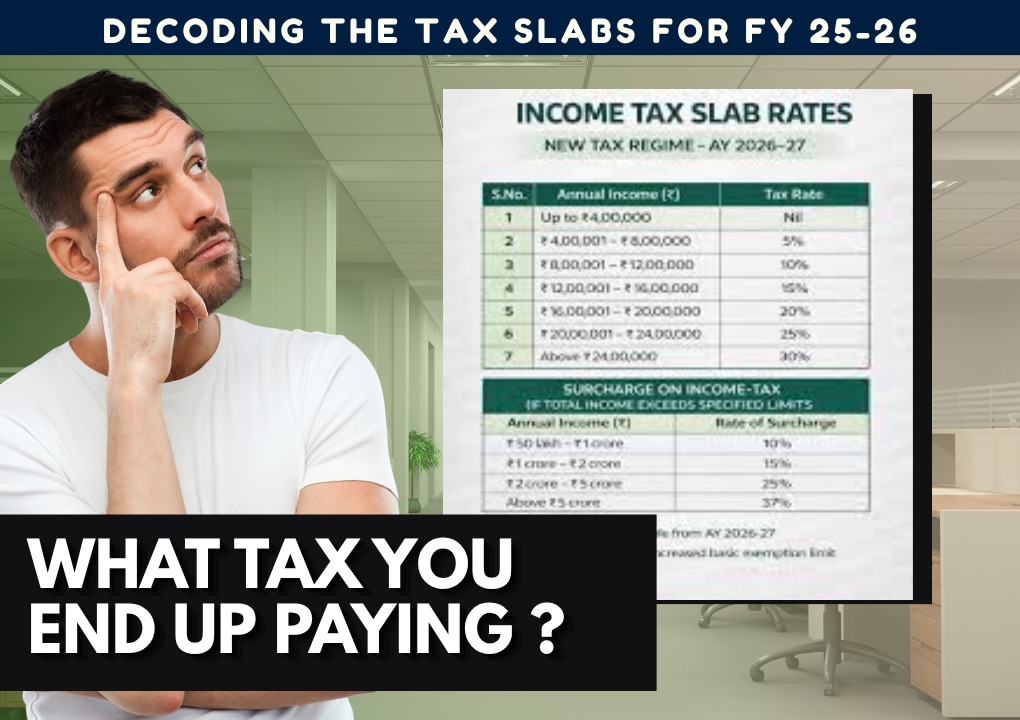
Income Tax Slabs Under New Tax Regime FY 2025-26
The revised new tax regime slabs applicable for FY 2025-26 are as follows:
| Annual Income | Tax Rate |
|---|---|
| Up to Rs. 4,00,000 | Nil |
| Rs. 4,00,001 – Rs. 8,00,000 | 5% |
| Rs. 8,00,001 – Rs. 12,00,000 | 10% |
| Rs. 12,00,001 – Rs. 16,00,000 | 15% |
| Rs. 16,00,001 – Rs. 20,00,000 | 20% |
| Rs. 20,00,001 – Rs. 24,00,000 | 25% |
| Above Rs.24,00,000 | 30% |
Additionally:
- Standard deduction available: ₹75,000 for salaried individuals and pensioners.
- Section 87A rebate can effectively make income up to ₹12 lakh tax-free under specified conditions, and up to ₹12.75 lakh for salaried individuals after considering the standard deduction.
Income Tax Slabs Under Old Tax Regime FY 2025-26
For individuals below 60 years:
| Annual Income | Tax Rate |
|---|---|
| Up to Rs. 2,50,000 | Nil |
| Rs. 2,50,001 – Rs. 5,00,000 | 5% |
| Rs. 5,00,001 – Rs. 10,00,000 | 20% |
| Above Rs. 10,00,000 | 30% |
The old regime continues to offer multiple deductions and exemptions that are unavailable under the new regime.
Important Additional Components Applicable in Tax Calculation
Regardless of regime selection, taxpayers must also consider:
Health & Education Cess
4% on total tax liability
Surcharge
Applicable for higher income categories beyond specified thresholds.
Special Income Taxation
Certain incomes are taxed separately:
- Short-term capital gains
- Long-term capital gains
- Lottery income
- Cryptocurrency taxation
These may not always qualify for rebate benefits.
Read More – India’s Income Tax Budget 2026: What It Really Changes for Individuals (And What It Doesn’t)
How to Calculate Tax Under New Tax Regime
Let us understand the exact process.
Step 1: Calculate Gross Income
Include:
- Salary.
- Bonus.
- Interest income.
- Rental income.
- Business income.
- Other taxable income.
Example: Salary = Rs. 15,00,000
Step 2: Deduct Standard Deduction
For salaried individuals:
Rs. 15,00,000
Less Rs. 75,000
Taxable Income = Rs. 14,25,000
Step 3: Check Allowed Deductions
Many deductions are unavailable.
However, certain benefits continue, such as:
- Employer contribution to NPS under eligible provisions.
- Certain specific allowances permitted under law.
Step 4: Apply Tax Slabs
Tax on Rs. 14.25 lakh:
- 0–4 lakh = Nil
- 4–8 lakh = 5%
- 8–12 lakh = 10%
- 12–14.25 lakh = 15%
Then add cess.
Step 5: Check Section 87A Rebate Eligibility
If eligible income falls within prescribed limits:
- Rebate may significantly reduce tax liability
However:
- Special-rate income such as STCG may not qualify.
How to Calculate Tax Under Old Tax Regime
Now let us see the old regime process.
Step 1: Calculate Gross Income
Example: Salary = Rs. 15,00,000
Step 2: Deduct Exemptions
Possible exemptions:
- HRA
- LTA
- Other eligible exemptions
Example:
HRA Exemption = Rs. 2,00,000
Balance Income = Rs. 13,00,000
Step 3: Deduct Chapter VI-A Deductions
Example:
Section 80C = Rs. 1,50,000
Section 80D = Rs. 25,000
Balance:
Rs. 11,25,000
Step 4: Home Loan Benefits
Suppose:
Section 24 deduction = Rs. 2,00,000
Taxable Income:
Rs. 9,25,000
Step 5: Apply Tax Slabs
Tax is now calculated on Rs. 9.25 lakh instead of Rs. 15 lakh.
This demonstrates why many taxpayers still find the old regime beneficial.
Major Deductions Under Old Tax Regime
Section 80C
Maximum limit:
Rs. 1.5 lakh
Includes:
- EPF
- PPF
- ELSS
- Life Insurance Premium
- NSC
- Home Loan Principal
Section 80D
Health insurance premiums.
Section 24
Home loan interest deduction.
HRA Exemption
One of the largest deductions for salaried individuals.
Especially relevant in:
- Pune
- Bengaluru
- Mumbai
- Hyderabad
- Delhi
NPS Benefits
Additional deductions available under specified provisions.
Deductions Commonly Missed by Taxpayers
Many taxpayers focus only on Section 80C.
They ignore:
- Health Insurance Premiums: Section 80D deductions are often underutilized.
- NPS Employer Contribution: Many salaried employees overlook this benefit.
- Home Loan Interest: Some taxpayers incorrectly claim or fail to claim allowable deductions.
HRA Optimization: Incorrect rent documentation often leads to the loss of benefits.
Most Common Myths About Income Tax
Myth 1: New Regime Means No Deductions
Not completely true.
Certain deductions remain available.
Myth 2: Higher Salary Means Entire Income Gets Taxed At Highest Slab
Wrong.
India follows slab-based taxation.
Only income within each slab gets taxed at that slab’s rate.
Myth 3: New Regime Is Better For Everyone
Incorrect.
Many taxpayers with:
- HRA
- Home loan
- Insurance deductions
still benefit from old regime.
Myth 4: Tax Saving Investments Should Be Done Only For Tax Benefit
Dangerous approach.
Investment decisions should align with:
- Goals
- Risk profile
- Time horizon
Not only tax reduction.
Myth 5: Rebate Means Entire Income Is Tax-Free
Not always.
Eligibility conditions apply.
Special-rate income may not qualify.
Common Mistakes While Choosing Tax Regime
Mistake 1: Comparing Slabs Instead Of Final Tax
Many taxpayers compare:
5% vs 20%
Instead of:
Actual tax liability.
Mistake 2: Ignoring HRA Impact
This is one of the biggest calculation errors.
Mistake 3: Forgetting Home Loan Deductions
Can significantly alter tax outcome.
Mistake 4: Ignoring NPS Benefits
Especially employer contribution benefits.
Mistake 5: Blindly Following Friends Or Colleagues
Two people earning identical salaries may require different regime selections.
Practical Thumb Rules
✦ New Regime Often Works Better If…
- Have no home loan
- Have limited deductions
- Do not claim HRA
- Prefer simplicity
✦ Old Regime Often Works Better If…
- Pay substantial rent
- Claim HRA
- Have a housing loan
- Maximize Section 80C
- Claim health insurance deductions
Real-Life Examples
Example 1: Young Salaried Professional
Income:
Rs. 12 lakh
No HRA
No home loan
Minimal deductions
Often:
New regime becomes attractive.
Example 2: Married Professional In Metro City
Income:
Rs. 18 lakh
HRA:
Rs. 3 lakh
80C:
Rs. 1.5 lakh
80D:
Rs. 25,000
Likely:
Old regime may remain competitive.
Example 3: Home Loan Holder
Income:
Rs. 20 lakh
Home loan interest:
Rs. 2 lakh
HRA:
Rs. 2 lakh
80C:
Rs. 1.5 lakh
Old regime often deserves careful evaluation.
Example 4: Freelancer
No HRA
No salary structure
New regime often becomes simpler and more efficient.
Special Care While Filing Returns
Before final submission:
Check:
- Form 16
- AIS
- Form 26AS
- Interest income
- Capital gains statements
Many notices arise because taxpayers ignore these reconciliations.
Frequently Asked Questions (FAQs)
If my salary is Rs. 12 lakh, do I pay zero tax under the new regime?
For most salaried individuals, yes — effectively. The Section 87A rebate eliminates tax on income up to Rs. 12 lakh under the new regime. Additionally, salaried individuals get a Rs. 75,000 standard deduction, which means if your gross salary is Rs. 12.75 lakh, your taxable income after the standard deduction is Rs. 12 lakh — and the rebate covers the full tax. However, if your income includes special-rate earnings like short-term capital gains, those may not qualify for the rebate and will be taxed separately.
How do I decide which tax regime is better for me?
The simplest approach is to calculate your actual tax liability under both regimes and compare. As a thumb rule: if you have significant deductions — HRA, home loan interest (Section 24), 80C investments, and health insurance (80D) — the old regime often works out cheaper. If you have few deductions or prefer simplicity, the new regime is usually more beneficial. Two people with the same salary can reach very different conclusions based on their individual financial situations.
Can I switch between the old and new tax regime every year?
Salaried individuals without business income generally can switch regimes each financial year when filing their return — whichever is more beneficial that year. However, taxpayers with business or professional income face additional restrictions: once they opt out of the new regime, they must file Form 10-IEA and may not be able to switch back freely in subsequent years. It is advisable to evaluate this before committing.
Under the new Tax regime, are there any deductions available at all?
Yes — a common misconception is that the new regime has no deductions. A standard deduction of Rs.75,000 is available to salaried individuals and pensioners. Employer contributions to NPS under eligible provisions are also deductible, and certain specific allowances permitted under law continue as well. What is largely unavailable are HRA exemption, home loan interest under Section 24, and the wide range of Chapter VI-A deductions like 80C, 80D, and 80G.
Does a higher salary mean my entire income is taxed at 30%?
No — India uses a slab-based progressive tax system, which means only the portion of your income that falls within a particular slab is taxed at that slab's rate. For example, if your taxable income is Rs. 25 lakh under the new regime, the first ₹4 lakh is taxed at nil, the next ₹4 lakh at 5%, the next Rs. 4 lakh at 10%, and so on. Only the amount above Rs. 24 lakh is taxed at 30%. Your effective tax rate will therefore always be lower than the highest slab rate that applies to your income.