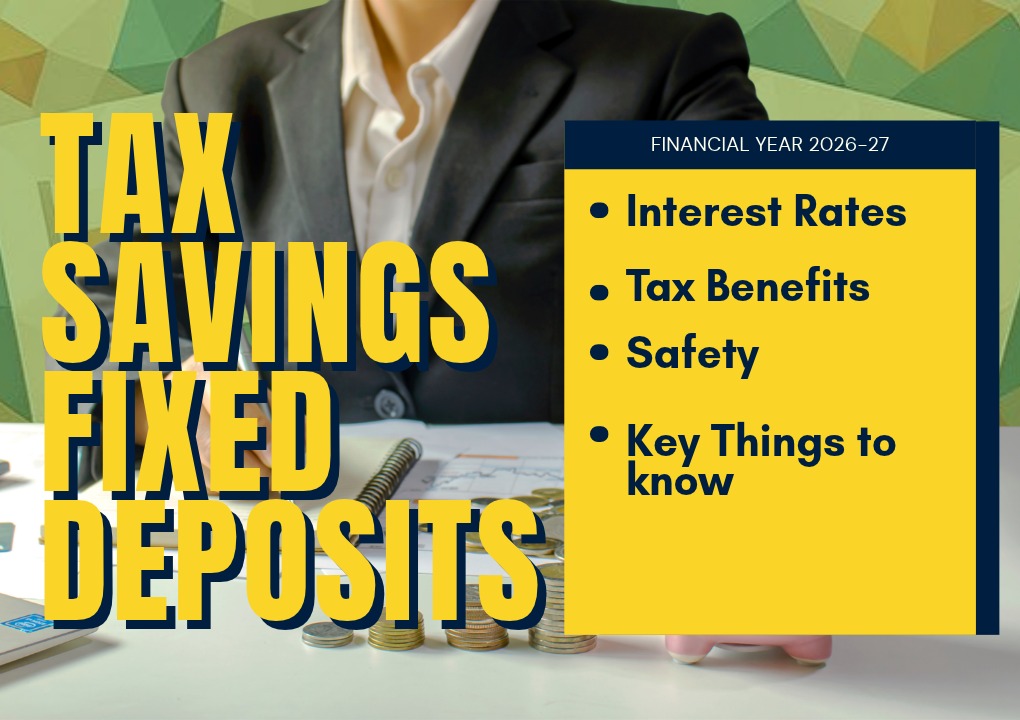
When people think about saving tax, investments like PPF, ELSS, and insurance often come to mind. Another simple option many investors consider is a Tax-Saving Fixed Deposit (FD).
A Tax-Saving FD is similar to a regular fixed deposit, but it has a five-year lock-in period and can offer a deduction under Section 80C if you are eligible and using the old tax regime.
It sounds simple, but investors should understand a few key things before investing.
What is a Tax-Saving FD?
A Tax-Saving FD is a special type of bank fixed deposit that combines fixed returns with a potential tax benefit.
Under the old tax regime, eligible investments under Section 80C can qualify for a deduction of up to Rs 1.5 lakh in a financial year. A Tax-Saving FD can be one of the investments used for this deduction, provided you have unused 80C capacity.
For example, suppose you invest Rs 1 lakh in a Tax-Saving FD. If you have enough remaining Section 80C limit, that Rs 1 lakh can potentially qualify for the deduction.
However, there is an important distinction:
The investment may qualify for a tax deduction, but the interest earned is not tax-free.
This is one of the most common points of confusion for investors.
Also, if you follow the new tax regime, the usual Section 80C deduction isn’t available. Therefore, investors should first understand which tax regime they are using before investing purely for tax-saving purposes.
Read Also: ITR Filing for AY 2026-27: Step-by-Step Complete Guide for Salaried Employees
How much interest can you earn in 2026?
Interest rates are one of the biggest factors investors look at when choosing an FD.
In 2026, some Small Finance Banks have offered Tax-Saving FD rates around 7–8%, while several large private and PSU banks have generally offered lower rates.
Bank rates are around 6.05%-8%.
These figures are reference rates only, as banks can change their FD rates over time.
Also, don’t assume the highest FD rate a bank advertises automatically applies to its Tax-Saving FD. Always check the specific five-year Tax-Saving FD rate before investing.
Read Also: Capital Gains Tax in India: How to Calculate the Tax While Filing Your ITR?
Small Finance Banks vs Big Banks — Which is Safer?
This is where the decision becomes more interesting.
Small Finance Banks sometimes offer higher interest rates than large private or PSU banks. Naturally, investors may wonder whether that higher interest comes with more risk.
Small Finance Banks are regulated, but investors should still understand the protection available for bank deposits.
The DICGC currently insures deposits up to Rs 5 lakh per depositor per bank, including principal and interest, subject to applicable rules.
For example, if you have deposits across two different insured banks, the insurance coverage is considered separately for each bank. But simply having multiple accounts in the same bank does not create a separate Rs 5 lakh insurance limit for every account.
This doesn’t mean investors should automatically avoid Small Finance Banks or assume that large banks have no risk. Instead, the bank’s financial position, deposit size, interest rate and your own comfort level should all be considered.
Read Also: Which ITR Form Should You File ITR-1, ITR-2, ITR-3, ITR-4 Explained Simply?
Five-Year Lock-In: What You Need to Know
The biggest difference between a Tax-Saving FD and a normal FD is the five-year lock-in.
Generally, you cannot withdraw the money prematurely during this period.
This makes Tax-Saving FDs better suited for money you know you won’t need soon.
For example, if you have Rs 2 lakh saved for an emergency, putting it all into a five-year Tax-Saving FD may not be a good fit because the money isn’t easily accessible.
Another important point is that the Rs 1.5 lakh Section 80C limit is an overall limit, not a separate limit for Tax-Saving FDs.
If you already have EPF, PPF, eligible life insurance premiums or other qualifying investments, part of your 80C limit may already be used.
Read Also: Top 10 Tax-Saving Investments Under Section 80C in India
Tax on FD Interest — The Common Misunderstanding
One of the biggest misconceptions about Tax-Saving FDs is that the entire investment becomes tax-free.
That’s not how it works.
The eligible investment can provide a Section 80C deduction under the old regime, but the interest earned on the FD is generally taxable.
For example, if your FD earns Rs 10,000 in interest, you generally add that interest to your taxable income under the applicable rules.
Banks may also deduct TDS when the relevant conditions and thresholds are met. However, TDS is not the same as your final tax liability.
This is why investors should focus on post-tax returns rather than simply comparing headline FD interest rates.
Read Also: Best Tax Planning Strategies for High Salary Professionals in India
Tax-Saving FD vs ELSS vs PPF
Tax-saving FDs, ELSS, and PPF are often discussed together because of their tax-saving features, but they are very different investments.
Tax-Saving FD
The main attraction is predictability. You know the interest rate when you book the FD, and the lock-in period is five years.
The downside is that the interest is taxable and your money remains locked in.
ELSS
ELSS, or Equity Linked Savings Scheme, invests primarily in equities and has a three-year lock-in.
Because it is market-linked, returns are not guaranteed. However, investors with a longer horizon may consider it when they are comfortable with market fluctuations.
PPF
PPF is designed for long-term savings and has a much longer maturity structure.
Investors generally consider it for long-term, relatively stable savings rather than market-linked returns.
The choice between these options ultimately depends on your risk tolerance, investment horizon, liquidity requirements and tax regime.
Read Also: Income Tax Guide for Indian Doctors
Final Thoughts
A Tax-Saving FD may not be the most exciting investment, but its simplicity attracts many investors. You get a fixed interest rate, a five-year lock-in and, if eligible under the old tax regime, a potential Section 80C deduction.
However, don’t choose an FD just because a bank offers a high interest rate. Before investing, check the actual Tax-Saving FD rate, lock-in period, withdrawal rules, interest taxation, DICGC coverage, and your remaining Section 80C limit.
And most importantly, remember that tax saving should not be the only reason to invest. The investment should also fit your financial goals, liquidity needs and overall portfolio.
Note: FD interest rates and bank terms can change. The rates mentioned above are 2026 reference figures and should be verified with the respective bank before investing. Tax treatment can vary depending on individual circumstances and the tax regime selected.
NS Wealth Solutions Pvt Ltd provides Fee-Based Mutual Fund advisory services all over India: Agra | Ahmedabad | Bangalore | Bhopal | Bhubaneswar | Chandigarh | Chennai | Coimbatore | Dehradun | Delhi | Guwahati | Hyderabad | Indore | Jaipur | Jamshedpur | Kanpur | Kolkata | Lucknow | Ludhiana | Mumbai | Nagpur | Nashik | Patna | Pune | Rajkot | Ranchi | Surat | Udaipur | Vadodara | Varanasi
Frequently Asked Questions and Answers
What is a Tax-Saving FD, and how does it work?
A Tax-Saving FD is a bank fixed deposit with a five-year lock-in. Under the old tax regime, the amount you invest can qualify for a Section 80C deduction of up to Rs 1.5 lakh in a financial year, if you have unused 80C limit.
Is the interest on a Tax-Saving FD tax-free?
No. Only the investment may qualify for the deduction. The interest you earn is generally taxable and is added to your income, and the bank may deduct TDS when the conditions and thresholds apply. Look at your post-tax return, not just the headline rate.
What are the Tax-Saving FD interest rates in 2026?
Reference rates range from about 6.05% to 8%. Some Small Finance Banks have offered around 7% to 8%, while many large private and PSU banks have offered less. Banks can change rates at any time, so check the specific five-year Tax-Saving FD rate before you invest.
Are Small Finance Bank FDs safe?
Small Finance Banks are regulated banks. DICGC deposit insurance covers up to ₹5 lakh per depositor per bank, including principal and interest, subject to the rules. Deposits in different insured banks are covered separately, but several accounts in the same bank share one limit. Consider the bank’s financial position and your comfort level as well as the rate.
Can I withdraw a Tax-Saving FD before five years?
Generally, no. The five-year lock-in means you cannot withdraw early, so it suits money you won’t need soon. Don’t put your emergency fund into one. Also remember that the Rs 1.5 lakh limit is shared with other 80C items such as EPF, PPF and life insurance premiums, and the deduction is not available under the new tax regime.