Introduction
For many Indian families, gold represents more than just an investment; it is bought during festivals, given at weddings, handed down from one generation to the next, and kept as a source of comfort when financial circumstances are unclear. Yet this familiarity can mask the drawbacks of owning gold in the form of jewellery or coins. Common problems include value loss due to making charges, difficulty assessing purity, the cost of safe storage, and difficulty selling at a fair price. To overcome these issues, gold-linked financial products have been developed to maintain the appeal of investing in gold.
Indian investors currently have many such options.
- Electronic Gold Receipts, or EGRs, are among the newer options and are regulated by the Securities and Exchange Board of India (SEBI).
- You can buy Gold Exchange Traded Funds (ETFs) & gold-based mutual fund schemes through your trading account or with the support of a Registered Investment Advisor.
- Digital gold is available on popular apps like Paytm, but it doesn’t have regulatory oversight.
At first glance, these alternatives might seem the same since each is based on the price of gold. But the difference lies in how the gold is held, how easily it can be sold, the costs involved, and the level of protection offered to the investor. The differences matter far more than the product name.
Read Also: Your Portfolio Is Suffering a Loss? Here’s What You Should Do?
Understanding SEBI’s Electronic Gold Receipts
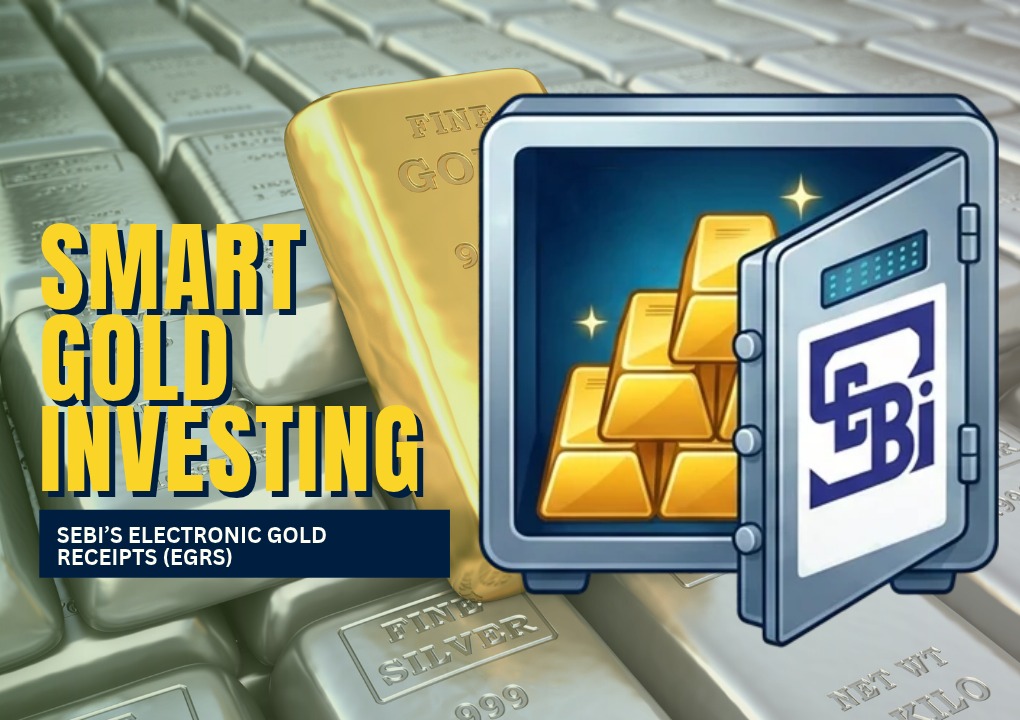
An Electronic Gold Receipt (EGR) serves as a digital receipt for actual gold held in a SEBI-approved vault. An investor can buy the same from either stock exchange, NSE or BSE. Unlike Sovereign Gold Bonds, which the Government issues, SEBI-registered vault managers issue EGRs. The process works in a way that includes three parties:
- The Depositors: This includes jewellers, gold refiners, and bullion traders who deposit their gold reserves with SEBI-registered vault managers.
- The Vault Managers: Popular ones include Sequel Logistics, Brinks India, and Malca-Amit JK Logistics. The Vault Manager tests and records the exact weight and purity of the physical gold bars. Along with their documentation, once verified, the Vault Manager logs the information into the depository system (such as NSDL or CDSL), which in turn creates EGR units.
- The investor: You can now buy these on popular stock exchanges, with the smallest EGR unit representing 100 milligrams of gold; on purchase, it is credited to your Demat account like stocks and bonds. In fact, investors can also take physical delivery of the gold by paying a fee to the vault manager and paying the purchase value.
The interesting part of this new system is how it links three distinct activities: depositing standardized gold, trading the electronic receipt, and withdrawing actual gold after handing over the receipt.
Vault managers handle custody, record-keeping, reconciliation, safeguards, complaints, and receipt creation or cancellation. Trading and clearing occur via the usual market channels. Electronic Gold Receipts (EGRs) have no mandatory maturity date so that investors can hold them like any open-ended mutual fund scheme.
Read Also: Paying for financial advice in 2026: What is the ideal option?
Other Gold Investment Options
Gold ETFs are already a well-known option for people who invest in the stock market. To do so, investors buy and sell units on an exchange; the fund aims to match domestic gold prices after accounting for expenses and small tracking differences. The fund holds gold or other gold-related assets, while investors own units rather than a specific bar. Although ETFs offer clear market prices and intraday trading, this convenience depends on the investor having a demat and brokerage account. It is also important to verify that the ETF actually trades regularly and stays close to its benchmark.
For people who don’t wish to trade on the exchange, mutual fund schemes that invest in gold are generally a more convenient option. Some of these schemes are known as funds of funds, meaning they invest in a Gold ETF. Investors can typically make contributions through a systematic investment plan even without a demat account and can redeem their investments at the relevant net asset value. The downside is that the scheme adds its own expenses on top of the expenses the underlying ETF has already incurred. Although the process may seem simpler, don’t overlook this extra layer of charges.
Digital gold may be the simplest product to start with, since you can open an app, deposit a small amount, and see your gold balance almost immediately. The company usually states that the gold it matches is held on the buyer’s behalf, with the option to receive a coin or jewellery later. The simplicity is appealing, particularly to new investors, but it may lead to a false sense of security. SEBI has cautioned that a great many digital-gold products are not securities and do not qualify as regulated commodity derivatives. If the provider, custodian, platform, or redemption process fails, investors may not benefit from the protections available in the regulated securities market.
Read Also: 6 Financial Tips for New Parents in 2026: Building a Secure Future for Your Child
Comparative Analysis
The first question I should ask when looking at these products is this: who is in charge of the arrangement? Electronic Gold Receipts (EGRs ) and Gold ETFs operate within systems regulated by SEBI. At the same time, gold mutual fund schemes fall under the mutual fund framework, with disclosures, custodians, intermediaries, and a standardized complaint-redressal system. On the other hand, a digital gold provider might provide audits or make contractual promises, but this should not be mistaken for the securities market’s oversight. For an investor investing for several years, that difference matters more than the convenience of buying gold with just a few taps.
Liquidity is another important headline feature, but it can be misleading. Although Electronic Gold Receipts ( EGRs) and ETFs can be sold during market hours, that doesn’t mean a listed product is easy to exit. When trading volume is low, the difference between the buying and selling price can become unwelcome. On the other hand, a gold mutual fund eliminates that, since the fund company, or AMC, promises to buy back shares at the relevant net asset value when you redeem your shares. Digital-gold platforms may also have a quick-sale option, but the price and the process still depend on the provider.
The third most important factor is costs, since each product hides them in a different place. An ETF has an expense ratio, and investors may also pay brokerage fees, demat charges, and the bid–ask spread. A gold fund of funds adds yet another level of expenses. EGRs can include brokerage fees, exchange fees, vaulting charges, and a large delivery bill if you want physical gold. With digital gold, the purchase price, sale price, taxes, delivery charge, and any storage fee can all affect the outcome. A practical way to compare the products is to ask yourself: if I invest now and sell later at the same gold price, how much of my money will I actually get back?
The final factor is taxation. The short-term capital gains tax rate is 12.5% for all types of financial gold options held for less than 12 months, while it is 24 months for digital gold. Another important tax is GST, which applies only to digital gold and EGRs, but you pay it for Electronic Gold Receipts (EGRs) if you take physical delivery of gold.
The meaning of ‘backed by gold’ varies by option. Exchange-traded gold funds are based on standard gold accepted into the regulated vaulting system. A Gold ETF holds assets under its scheme documents and custody rules, but investors own units of the fund, not specific pieces of gold. A mutual fund gold scheme generally gains gold exposure through an ETF. With digital gold, the degree of backing depends on the provider’s agreement terms, storage arrangements, audits, and redemption terms. Although the phrase may sound reassuring, the details behind it matter.
For ordinary investors, digital gold and mutual fund schemes allow them to start with small amounts and minimal effort. ETFs are available to anyone, but they add the complexity of opening a trading and demat account with a broker. Although Electronic Gold Receipts (EGRs) provide a more direct link to physical gold and have similar complexity to ETFs, their low trading activity, limited denominations, and delivery arrangements may make them less convenient for certain retail investors. The most sophisticated product need not be the most suitable.
Read Also: Income Tax Guide for Indian Doctors 2026
The Role of Gold in an Investment Portfolio
While gold can have a place in a portfolio, it shouldn’t be relied on to serve every function. Qualified financial advisors call it a hedge against equity. Remember, it doesn’t pay interest or dividends, and returns come from price movements.
Gold is one of the oldest investment assets in the world, and its price movements also reflect global economic growth. For a layperson investor, we can broadly divide all investment assets into two categories: dollar-denominated and gold-denominated. For this reason, gold has historically behaved differently from shares and credit-sensitive investments when inflation occurs, the currency weakens, or financial stress increases. For Indian investors, rupee fluctuations also affect local gold prices. So, gold may buffer shocks rather than prevent losses.
The amount you should allocate depends on your investment objectives. Gold is not a good replacement for an emergency fund since its value can drop precisely when you need it. Someone saving for a wedding in two years will view the issue differently from someone saving for retirement in twenty years. A balanced allocation can decrease reliance on any one asset class and include a store-of-value feature. On the other hand, allocating too much to gold may hinder long-term growth, since gold does not generate income. It is generally more reasonable to select a range and rebalance periodically than to buy after a sharp price rise.
Read Also : Top Reasons Why You Must Plan Your Finances
Practical Considerations for Indian Investors
For an investor to decide which options suit them better, they should ask a few straightforward questions:
- Do I want mere exposure to gold as an investment option or ultimately want to hold the metal itself?
- Do I have a demat account? Some options require one.
- Am I likely to invest a small amount each month?
- What is my preferred choice, simple redemption or intraday trading?
- How much regulatory and custody risk am I willing to take?
With these questions, you can make a decision that fits you.
For an investor who is comfortable using a broker, a liquid Gold ETF might be the simplest choice after considering expenses, tracking differences, and trading spreads. Someone who wants to make automatic monthly contributions and does not have a demat account might prefer a mutual fund gold scheme, even if it costs slightly more. Electronic Gold Receipts (EGRs) could attract individuals looking for regulated exchange trading and a more direct connection to physical gold, provided they understand the vaulting and delivery process. Although digital gold is still convenient for small purchases, convenience alone is not enough to justify ignoring its lack of regulation.
Whichever route is chosen, a little homework goes a long way. The investor should read the scheme document or contract, list all charges, check liquidity, understand how redemptions work, and verify whether the intermediary is regulated. Gold may feel safe because it is familiar, but the product wrapped around it can still introduce risk. Anyone considering a large allocation, dealing with complex taxes, or balancing several financial goals may benefit from speaking with a SEBI-registered investment adviser who can review the entire portfolio rather than promote a single product.
Read Also : Best Tax Planning Strategies for High Salary Professionals in India
Conclusion
Indians investing in gold are no longer confined to purchasing jewellery, coins, or bars. With the rapid financialization of household savings, investors are looking at options like ETFs, Gold mutual fund schemes, and digital gold. The new SEBI-regulated Electronic Gold Receipt (EGR) is another option they can consider.
Electronic Gold Receipts (EGRs) place standardized physical gold into a regulated exchange system, offering two options: an avenue to invest and the option to take delivery of the physical metal. If you’re looking for investment alternatives, Gold ETFs offer familiar, market-based exposure, and mutual fund schemes make regular investing easier. Digital gold has its own advantage: simplicity. But it’s less favourable because it lacks regulatory oversight.
Read Also : How to File ITR Online on the New Income Tax Portal — Beginner’s Guide (AY 2026-27)
Each option addresses a different problem, but each also involves its own compromises. As an investor, the right choice matches your purpose, habits, and tolerance for cost and risk. Consider regulation, liquidity, custody, taxation, and redemption. Gold exposure can add diversification, but it should sit alongside productive investments and adequate cash reserves, not replace them. As India’s bullion market grows, Electronic Gold Receipts (EGRs) may become increasingly important for improving price discovery and formalizing gold ownership. Until then, a careful comparison and a restrained allocation remain the most sensible approach.
This essay is being used for educational purposes and should not be regarded as individual investment or tax advice.
NS Wealth Solutions Pvt Ltd is a Fee-only financial Advisor in india and provides financial advisory services all over India : Agra | Ahmedabad | Balasore | Bangalore | Bhopal | Bhubaneswar | Chandigarh | Chhatrapati Sambhaji Nagar | Chennai | Coimbatore | Dehradun | Delhi | Ghaziabad | Greater Noida | Gurugram | Guwahati | Hyderabad | Indore | Jaipur | Jamshedpur | Kanpur | Kolhapur | Kolkata | Lucknow | Ludhiana | Mumbai | Nagpur | Nashik | Navi Mumbai | Noida | Patna | Pimpri Chinchwad | Pune | Rajkot | Ranchi | Sangli| Surat | Thane | Udaipur | Vadodara | Varanasi
Frequently Asked Questions and Answers
Ques: What are the main ways to pay for financial advice in India?
Ans: The two main options discussed are fixed-fee and Asset Under Advice (AUA)-based fees. The right choice depends on the client’s needs, the services required, and the nature of the advisor-client relationship.
Ques: What are Electronic Gold Receipts (EGRs)?
Electronic Gold Receipts (EGRs) are digital receipts representing physical gold stored in SEBI-approved vaults. Investors can buy and sell them on Indian stock exchanges such as NSE and BSE, and may be able to take physical delivery of the underlying gold, subject to applicable fees and procedures.
Ques: What is the difference between EGRs and Gold ETFs?
EGRs represent standardised physical gold held in regulated vaults and can provide an option for physical delivery. Gold ETFs are exchange-traded units designed to provide exposure to domestic gold prices, but investors own fund units rather than specific gold bars. Both require a Demat and trading account.
Ques: Is Digital Gold regulated by SEBI?
Digital gold products available through apps are not generally regulated by SEBI in the same way as securities-market products such as EGRs, Gold ETFs and mutual funds. SEBI has cautioned that many digital-gold products are not securities or regulated commodity derivatives, so investors should understand the provider’s custody, contractual and redemption arrangements.
Ques: Which is better for monthly investment: Gold ETF or Gold Mutual Fund?
Gold Mutual Funds can be convenient for investors who want to invest through SIPs without a Demat account. Gold ETFs offer exchange trading and intraday liquidity but generally require a Demat and trading account. Gold Mutual Funds may also involve an additional layer of expenses because some invest in Gold ETFs.
Ques: Can Electronic Gold Receipts (EGRs) be converted into physical gold?
Yes. According to the article, EGR investors can take physical delivery of the underlying gold by surrendering the EGR and paying the applicable delivery-related fees and purchase value. The relevant vaulting arrangement handles the process.